




404
+1-313-307-4176
sales@stratviewresearch.com

Military 3D Printing Market Analysis | 2022-2027

Military 3D Printing Market Size, Share, Trends, Dynamics, Forecast, & Growth Analysis: 2022-2027
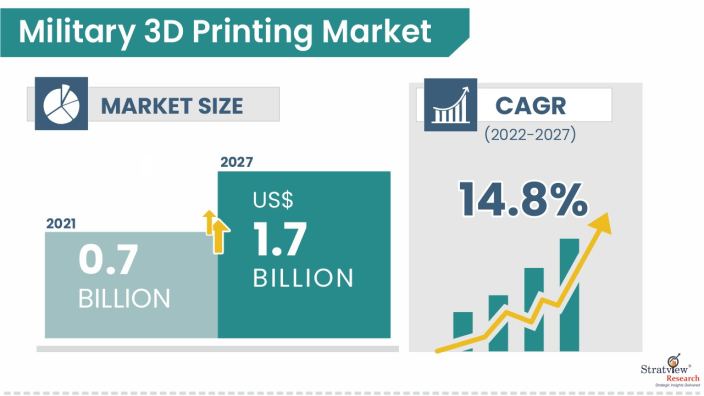
The military 3d printing market was estimated at USD 0.7 billion in 2021 and is likely to grow at a CAGR of 14.8% during 2022-2027 to reach USD 1.7 billion in 2027.
Want to know more about the market scope? Register Here
3D printing is one of the emerging technologies of industry 4.0 or the fourth industrial revolution, which is used to create a three-dimensional object through the layer-by-layer deposition of material by utilizing the computer-created design. The significance of 3D printing in the military is of paramount importance, as it offers rapid production of parts and supports military readiness on the battlefield.
Furthermore, it shortens the supply chain as the required parts/structures can be self-produced anywhere and anytime. However, the utilization of this technology is still at the introduction stage as it is majorly used to produce prototypes and perform analysis for its suitability for the military before its use in real operations.
Military 3D-Printing, a sizeable market, also was not able to resist the attack of the pandemic and witnessed a decline of -3.8% in 2020 amid the pandemic. However, the industry gradually rebounded in 2021 with the resumption of manufacturing facilities, availability of materials, the continuation of pending projects, etc.
Furthermore, the growth of 3D-printing applications, the emergence of new technologies, increasing flexibility of materials, etc. would support the growth of the market in the coming years.
|
Segmentations |
List of Sub-Segments |
Dominant and Fastest-Growing Segments |
|
Platform-Type Analysis |
Airborne, Naval, and Land |
Airborne platform is the largest and the fastest-growing platform type in the market during the forecast period. |
|
Offering-Type Analysis |
Printer, Material, Software, and Service |
Printer is expected to remain the dominant offering type in the market during the forecast period. |
|
Application-Type Analysis |
Prototyping, Parts Manufacturing, and Tooling |
Prototyping applications will remain the largest application type in the market during the forecast period. |
|
Process-Type Analysis |
Material Extrusion, Powder Bed Fusion, VAT Photopolymerization, Binder Jetting, Directed Energy Deposition, and Others |
Material Extrusion will remain the most preferred process type in the market during the forecast period. |
|
Regional Analysis |
North America, Europe, Asia-Pacific, and Rest of the World |
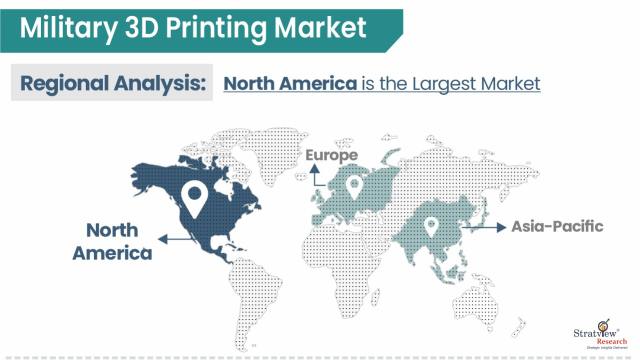
North America will remain the largest market, while Asia-Pacific is expected to grow the fastest during the forecast period. |
"Airborne platform is the largest and the fastest-growing platform type in the market during the forecast period."
"Printers are expected to remain the dominant offering type in the market during the forecast period."
"Prototyping applications will remain the largest application type in the market during the forecast period.”
"Material Extrusion will remain the most preferred process type in the market during the forecast period."
“North America will remain the largest market, while Asia-Pacific is expected to grow the fastest during the forecast period”.
Know the high-growth countries in this report. Register Here
The market for military 3D printing is consolidating as the major companies are performing mergers & acquisitions to quickly gain the leading position and to tap growing opportunities in this briskly expanding market. For instance, Desktop Metal, Inc., a leading provider of metal and carbon fiber 3D-printing solutions, acquired The Exone Company.
The supply chain of this market comprises several nodes, including suppliers and distributors of 3D-printed parts, printers, materials, 3D-printing software providers, 3D-printing service providers, OEMs, and MRO companies using 3D printing.
The following are the key players in the market (arranged alphabetically):
Note: The above list does not necessarily include all the top players in the market.
Are you the leading player in this market? We would love to include your name. Write to us at sales@stratviewresearch.com
This report provides market intelligence in the most comprehensive way. The report structure has been kept such that it offers maximum business value. It provides critical insights into market dynamics and will enable strategic decision-making for existing market players as well as those willing to enter the market. The following are the key features of the report:
This report studies the market, covering a period of 12 years of trends and forecasts. The report provides detailed insights into the market dynamics to enable informed business decision-making and growth strategy formulation based on the opportunities present in the market.
The military 3D printing market is segmented into the following categories:
By Platform Type
By Offering Type
By Application Type
By Process Type
By Region
This strategic assessment report, from Stratview Research, provides a comprehensive analysis that reflects today’s military 3D printing market realities and future market possibilities for the forecast period of 2022 to 2027. After a continuous interest in our military 3D printing market report from the industry stakeholders, we have tried to further accentuate our research scope to the military 3D printing market to provide the most crystal-clear picture of the market. The report segments and analyses the market in the most detailed manner to provide a panoramic view of the market. The vital data/information provided in the report can play a crucial role for the market participants as well as investors in the identification of the low-hanging fruits available in the market as well as to formulate the growth strategies to expedite their growth process.
This report offers high-quality insights and is the outcome of a detailed research methodology comprising extensive secondary research, rigorous primary interviews with industry stakeholders, and validation and triangulation with Stratview Research’s internal database and statistical tools. More than 1000 authenticated secondary sources, such as company annual reports, fact books, press releases, journals, investor presentations, white papers, patents, and articles, have been leveraged to gather the data. We conducted more than 15 detailed primary interviews with the market players across the value chain in all four regions and industry experts to obtain both qualitative and quantitative insights.
With this detailed report, Stratview Research offers one of the following free customization options to our respectable clients:
Company Profiling
Competitive Benchmarking
Custom Research: Stratview Research offers custom research services across sectors. In case of any custom research requirement related to market assessment, competitive benchmarking, sourcing and procurement, target screening, and others, please send your inquiry to sales@stratviewresearch.com.
3D printing is one of the emerging technologies of industry 4.0 or the fourth industrial revolution, which is used to create a three-dimensional object through the layer-by-layer deposition of material by utilizing the computer-created design. The significance of 3D printing in the military is of paramount importance as it offers rapid production of parts and supports military readiness on the battlefield.
The military 3d printing market is likely to grow at a CAGR of 14.8% during 2022-2027.
The forecasted value of the military 3d printing market is expected to be USD 1.7 billion in 2027.
North America is estimated to remain dominant in the market in the foreseeable future.
Asia-Pacific is likely to grow at the fastest pace for rapid 3D printing growth, fueled by high defense spending and extensive regional research.
GE Aviation (GE Additive), 3D Systems Corporation, Stratasys Ltd., OC Oerlikon Management AG, Markforged Inc., The Exone Company (Now a part of Desktop Metal Inc.), Proadways Group, Optomec, Inc, and Wipro Infrastructure Engineering (Wipro 3D) are the leading players in the market.
The military 3d printing market was estimated at USD 0.7 billion in 2021


WE ACCEPT